The exhibition 20th-Century Czech Art and Its Labels presents labels that are used to define the chronology of 20th-century Czech art and are commonly found as chapter headings in art history publications: the Mařák School, sculpture, Symbolism, Cubism, Surrealism, Group 42, (un)official art in 1948–1989, the eighties generation, the 1990s. Each of these “boxes” represents a broader category (a school, an -ism, etc.), but they also define particular groups of works and artists and present us with different challenges.
Detail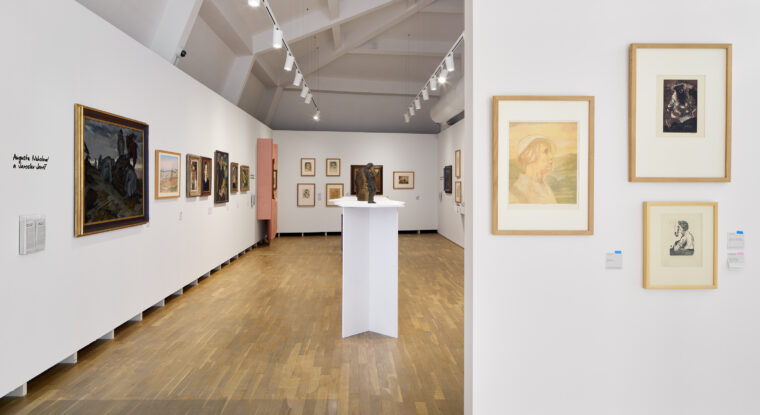
The exhibition explores the phenomenon of artistic partnerships in the visual arts, meaning the relationship between married artists or life partners, with a focus on artists whose personal and artistic careers unfolded against the historical upheavals of the 20th century. The exhibition’s chronological arrangement traces the evolution of the various relationships and the partners’ changing status in the different social and political conditions. Their process of artistic creation was influenced by external circumstances and by small, personal, everyday stories.
Detail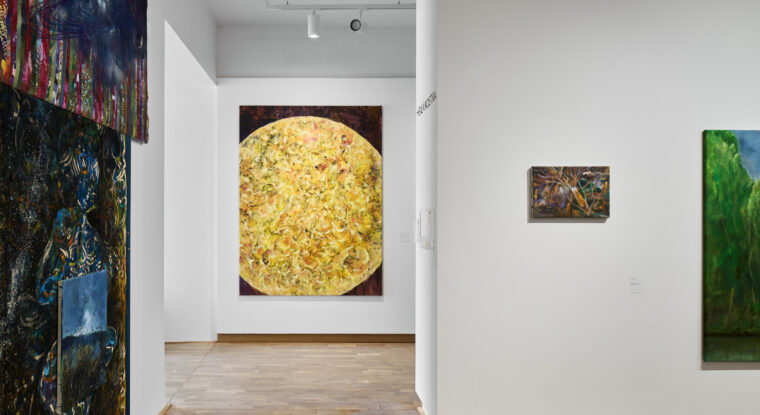
Jan Pražan’s work revisits questions that landscape painters have been asking themselves since at least as far back as the Romantic era. How should we understand the “religious” awe that landscape inspires? Can one arrive at a “deeper” understanding within it – and can we take these experiences seriously, without quotation marks, or will they always carry a hint of suspicious esotericism?
Detail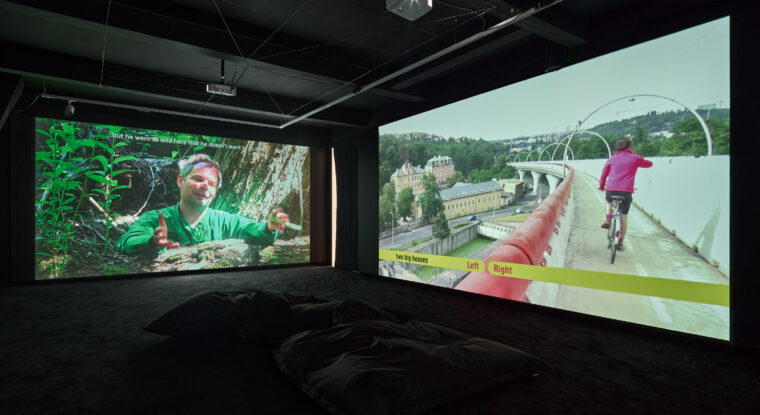
The exhibition at the Black Cube, GMU’s exhibition space for works from the gallery’s Moving Image Collection, presents Erik Sikora’s new video Narwhal Navigation (2026), which loosely follows on from his older works The Endless Exhibition and The Invention of Navigation (2007). The videos are a part of Sikora’s long-term exploration of the relationship between the body, the landscape, technology and language. His starting points are movement through the landscape and verbal dialogue. His works also explore our changing conditions for perceiving and interpreting the world. The relationship between the body, the landscape, audiovisual record and language is altered by the advent of new technologies whose present form was scarcely imaginable when he was making his older videos.
Detail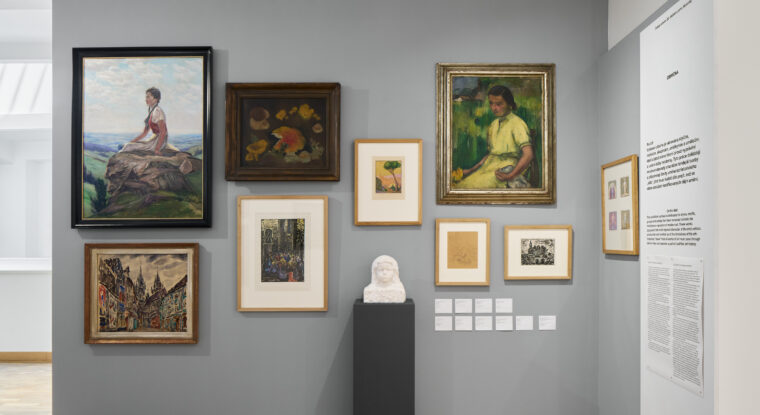
The exhibition surface On the Wall, which is part of the permanent exhibition 20th-Century Czech Art and Its Labels, is dedicated to styles, motifs, groups and artists that have remained outside the mainstream narrative of modern art. These works document the multi-layered character of the era’s artistic production and remind us of the limitations of the art-historical “sieve” that all works of art must pass through before they can become a part of codified art history.
Detail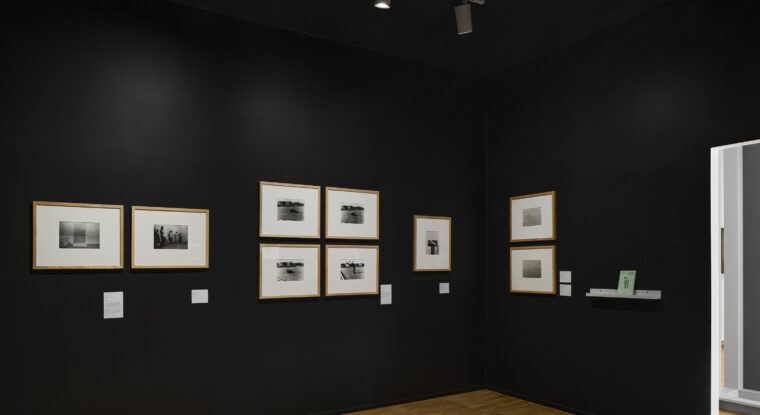
The exhibition space Behind the Wall, which is part of the permanent exhibition 20th-Century Czech Art and Its Labels, is dedicated to artists who in 1948–1989 worked outside official structures of cultural policy – either on the underground scene or in the grey area overlooked by official institutions. They often created experimental works, action art, happenings or other intangible or temporary installations. Seen from today’s perspective, these works – created and shown “behind the walls” of studios, homes or weekend cottages – are some of the conceptually richest artistic documents of that era.
Detail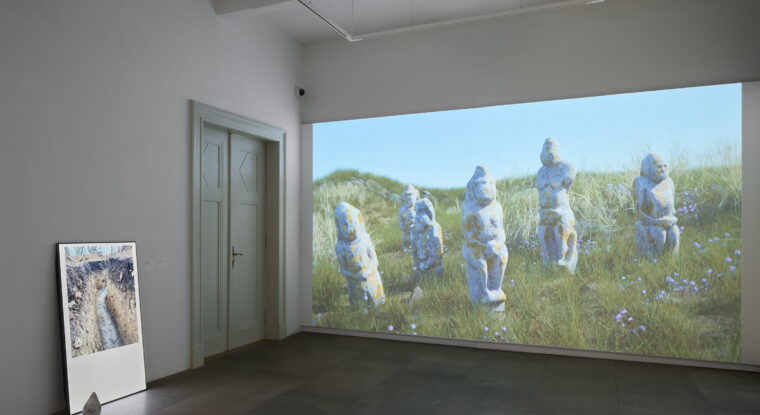
This intimate gallery space Na bidýlku II presents works by the youngest generation of artists, current students and art school graduates. Its name and mission recall the activities of the gallerist Karel Tutsch, whose collection was acquired by GMU in 2021.
DetailJiří Valoch’s artistic practice has been fundamentally defined by a sensitivity to language since the mid-1960s. Valoch created his first textual installation in the spring of 1970, during the last pioneering years of conceptual art. From an interview with Hans Ulrich Obrist, we know that this piece was a minimal object poem titled ticho (silence), and that it was included in an exhibition by the Club of Concretists at Brno’s House of the Lords of Kunštát (13–30 March 1970). In this single word, rendered in black on a white, horizontally oriented panel, special emphasis was placed on the letter “i” – by “dotting” it from both above and below, Valoch disrupted the word’s conventional semantics, leaving the viewer uncertain how to approach the work and how to interpret it.
Detail
Presented in the form of an open depository, the exhibition Vladimír Preclík’s Gift to the Hradec Králové Region includes all the works from a collection donated by the sculptor Vladimír Preclík (fifty-four works in total), supplemented by other works from the collection of the Gallery of Modern Art in Hradec Králové.
Detail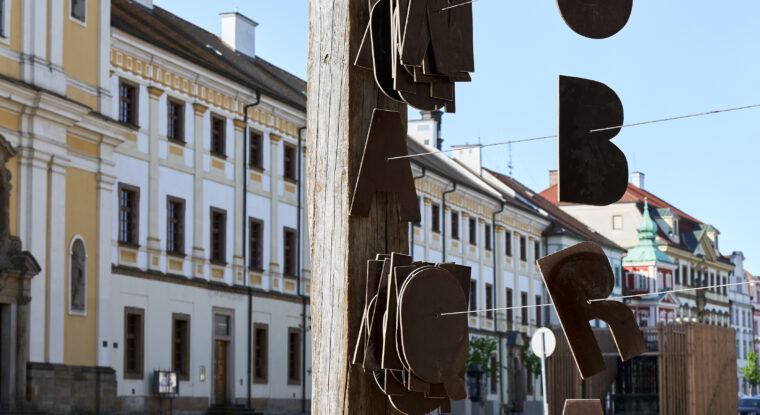
Wish consists of two columns between which five steel cables are stretched. Letters of the alphabet hang from the cables, which visitors can manipulate to form various five-letter words in a vertical formation. The interactive installation encourages viewers to engage in literary playfulness or to leave a message for the next visitor. That visitor can in turn replace that message with their own, thus the content of the Wish is constantly changing.
Detail
Hradec Králové’s Velké náměstí (Great Square) is currently dominated by cars. This large parking area in the historic city centre has been the scene of clashing opinions regarding the square’s current and future use. On the one hand are voices in favour of preserving parking and in support of car traffic, while on the other hand there is an interest in designing public space for people and their daily activities. Czech society has generally cherished its cars and placed them on an untouchable pedestal, but there is currently debate throughout the country as to whether public space should be more accommodating to people or to cars.
Detail