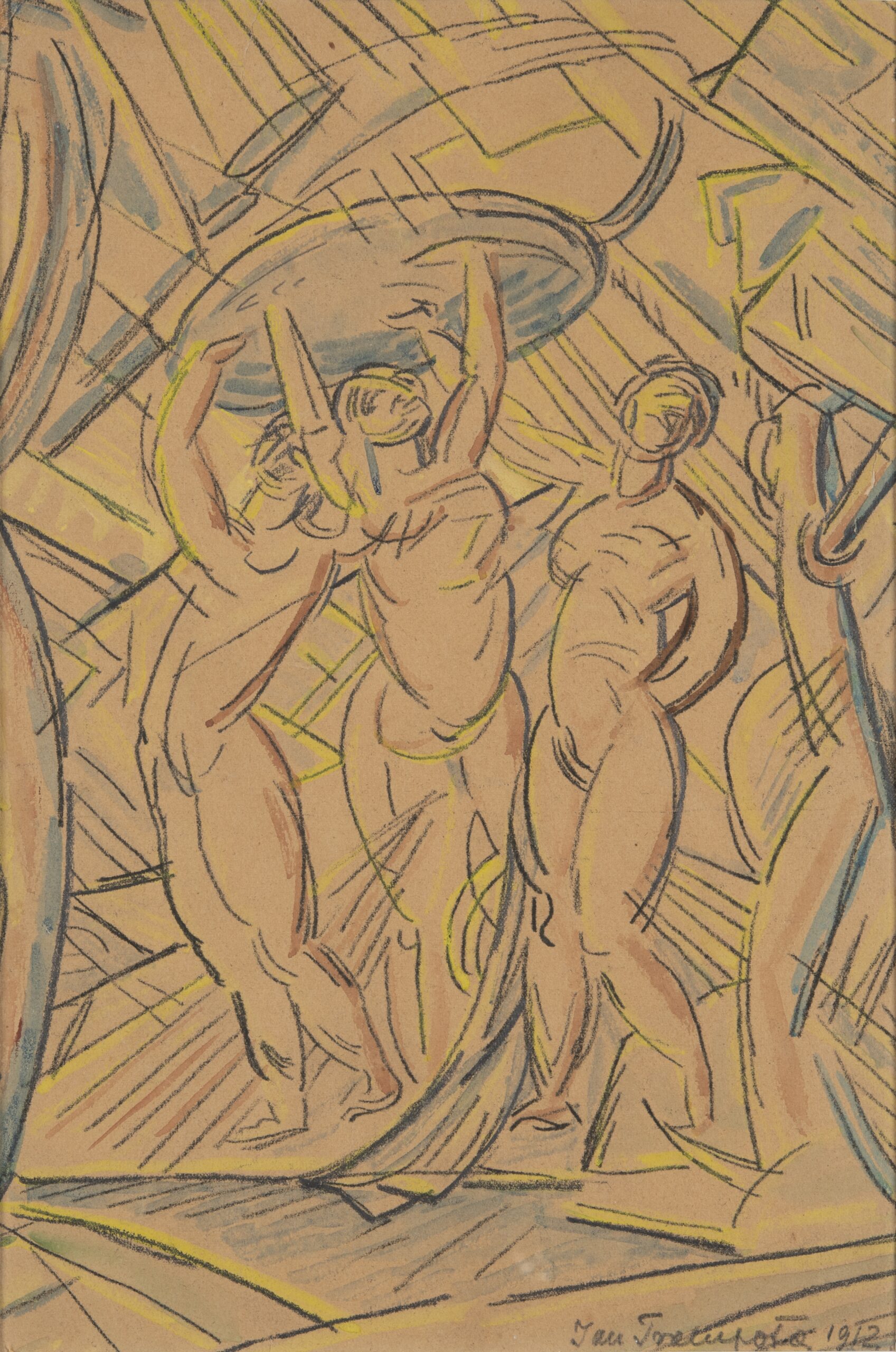
The exhibition surface On the Wall, which is part of the permanent exhibition 20th-Century Czech Art and Its Labels, is dedicated to styles, motifs, groups and artists that have remained outside the mainstream narrative of modern art. These works document the multi-layered character of the era’s artistic production and remind us of the limitations of the art-historical “sieve” that all works of art must pass through before they can become a part of codified art history.
Within the history of Czech modern art, JAN TRAMPOTA (1889–1942) is mainly remembered for his landscape paintings of the Eagle Mountains (Orlické hory). These works, however, represent just one part of his oeuvre. Besides landscapes, Trampota also created figure paintings, nudes, portrait studies and drawings that reflect his ties to European modernism and his Cubist-oriented approach to form.
Trampota belonged to the young generation of artists who, in the period before the First World War, sought out new ways of constructing the image. In 1913, he joined the Mánes Association of Fine Artists, which introduced Czech audiences to the latest artistic tendencies, in particular French modern painting.
Trampota’s artistic position was shaped in part by his time at Prague’s School of Applied Arts, where he studied under Emanuel Dítě in 1907–1909 while concurrently attending evening nude painting classes led by Jan Preisler. In fact, it was thanks to Preisler that Trampota deepened his interest in the figure as a bearer of expressiveness, inner dynamism and compositional tension. Preisler’s approach to drawing presented him with the possibility of understanding the body not just from the perspective of anatomy, but primarily as a relationship between line, volume and posture and as the arrangement of the picture plane. Trampota developed this approach most visibly in his drawings. In his hands, the nude or portrait study became a space in which the human figure was transformed into a distinctive visual form. Cubist thinking allowed him to articulate the figure in a new way while focusing on the construction of form. The line defines volume, determines rhythm and establishes the drawing’s fundamental order.
After the First World War, Trampota’s artistic production gradually moved away from its avant-garde beginnings and turned towards the landscape. This shift was part of the broader return to order, structured forms and natural themes that gained ground in European art with the emergence of neoclassical tendencies. In 1923, Trampota settled in Pěčín in the Eagle Mountains, whose landscape formed the main subject of his subsequent work. But his experience with the Cubist construction of the image did not entirely disappear and found expression in the way the hills, paths, cottages and horizons in his paintings are compiled into solidly organized landscape units.
Trampota’s landscapes brought him his greatest popularity and eventually came to determine how he was remembered after his death. His reputation as a painter of the Eagle Mountains was further cemented by a comprehensive exhibition of his paintings held in 1927 at the Municipal Museum of Industry in Hradec Králové.
The exhibited selection of drawings allows us to present Trampota beyond his usual categorization as a “landscape artist of the Eagle Mountains”. It shows him as an artist who absorbed various impulses from modern art without tending towards one particular style. The works on display turn our attention to a lesser-known yet important part of his oeuvre – his work with the body, line and volume.
The exhibition was supported by the Ministry of Culture of the Czech Republic and the Statutory City of Hradec Králové.