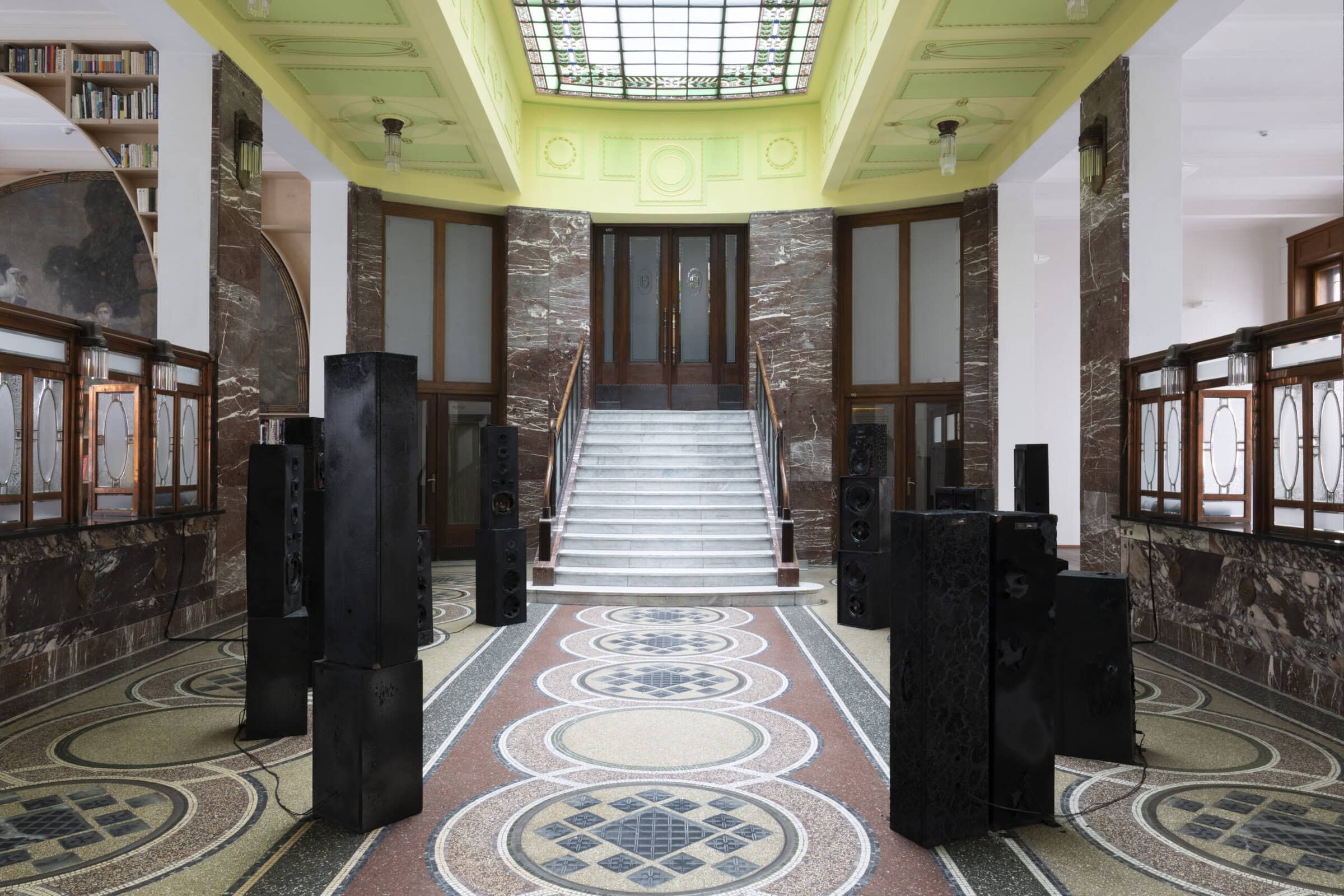
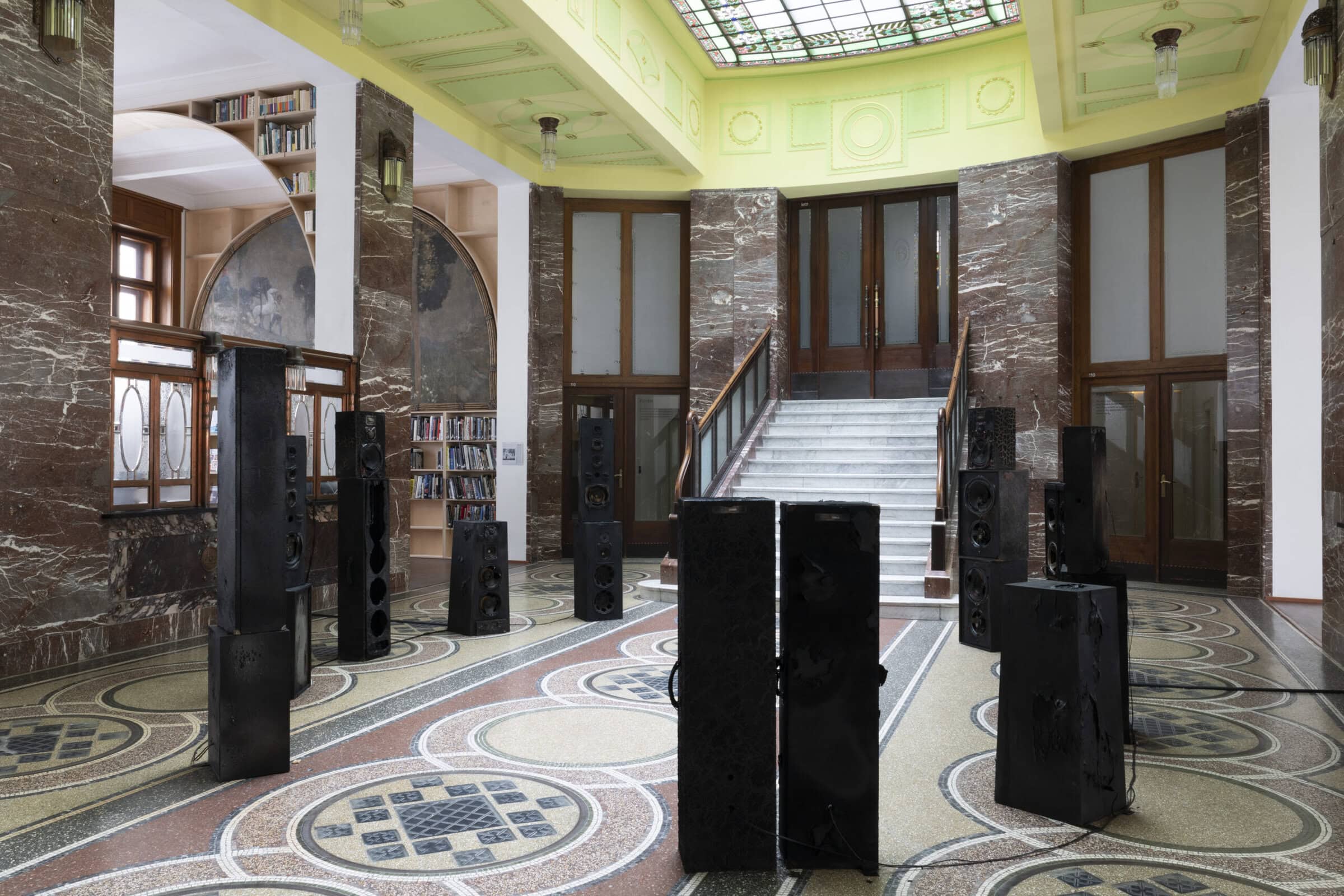
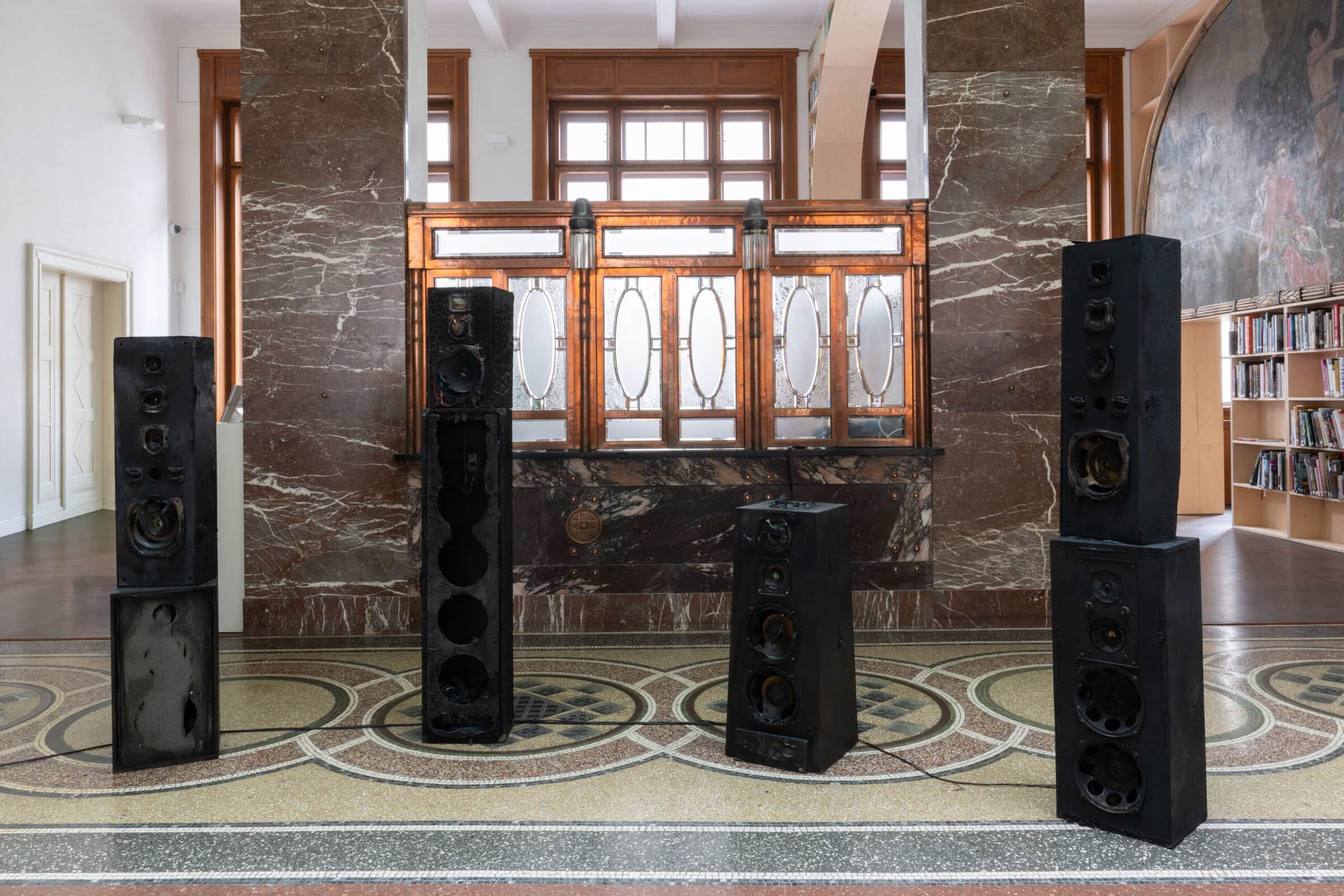
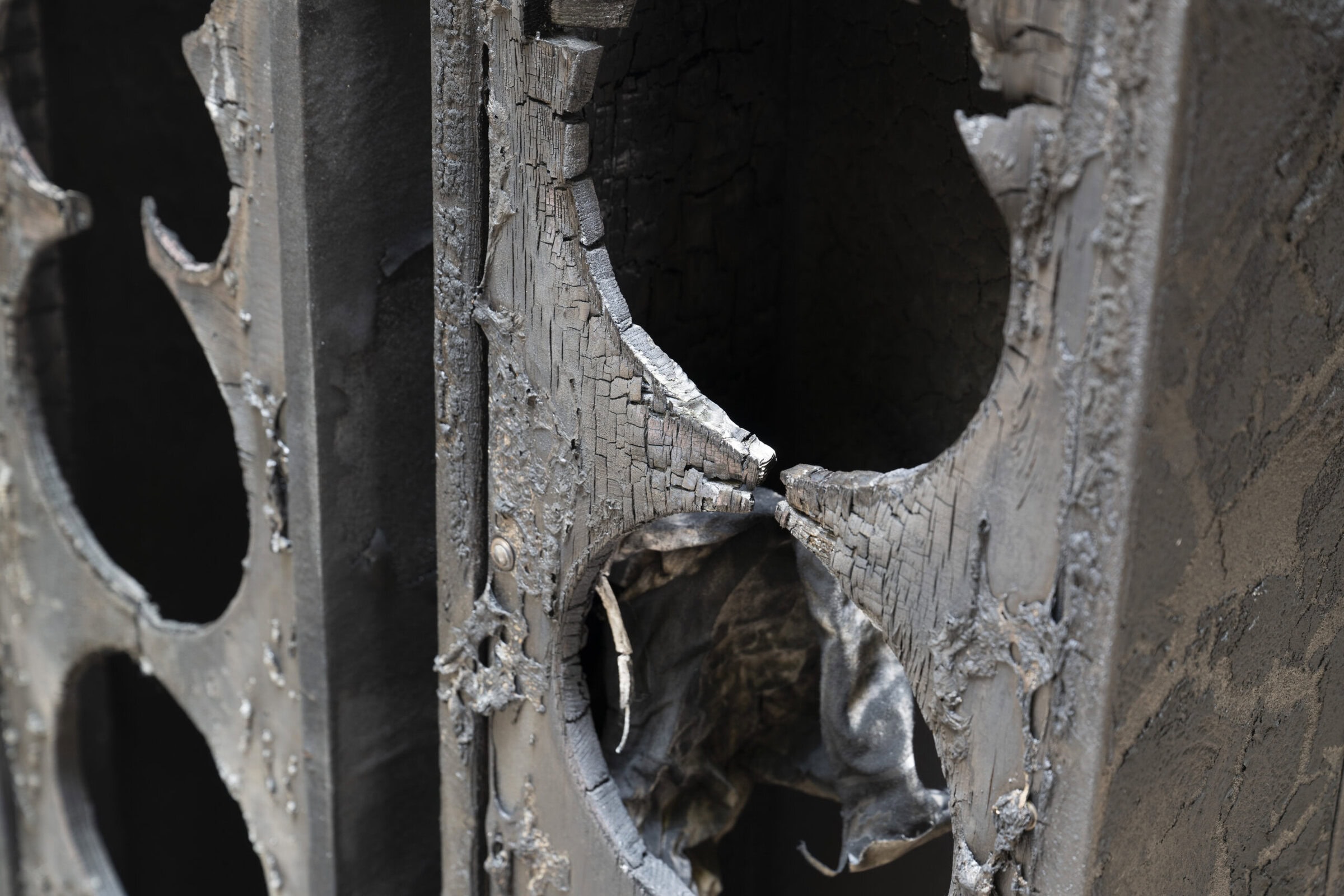
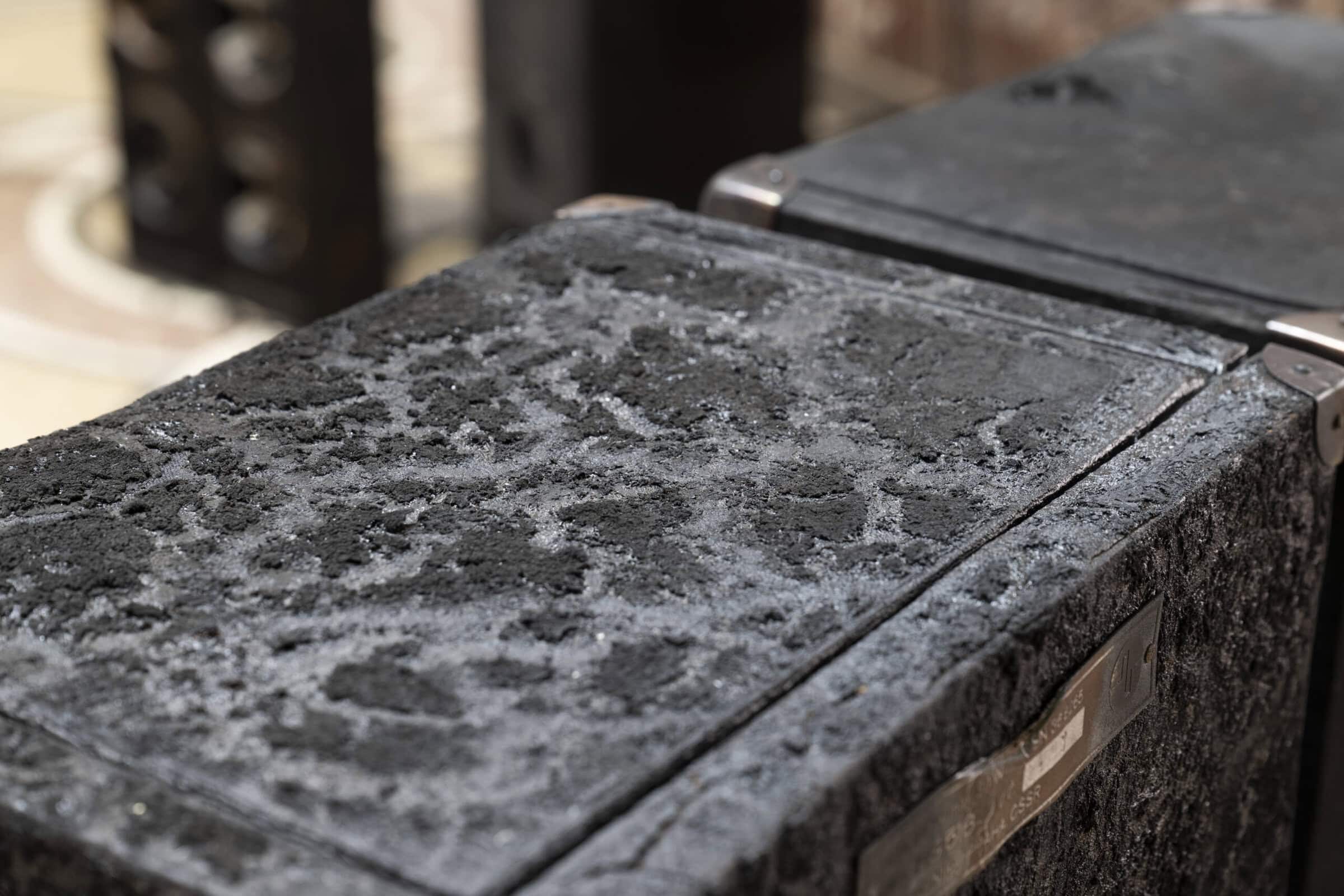
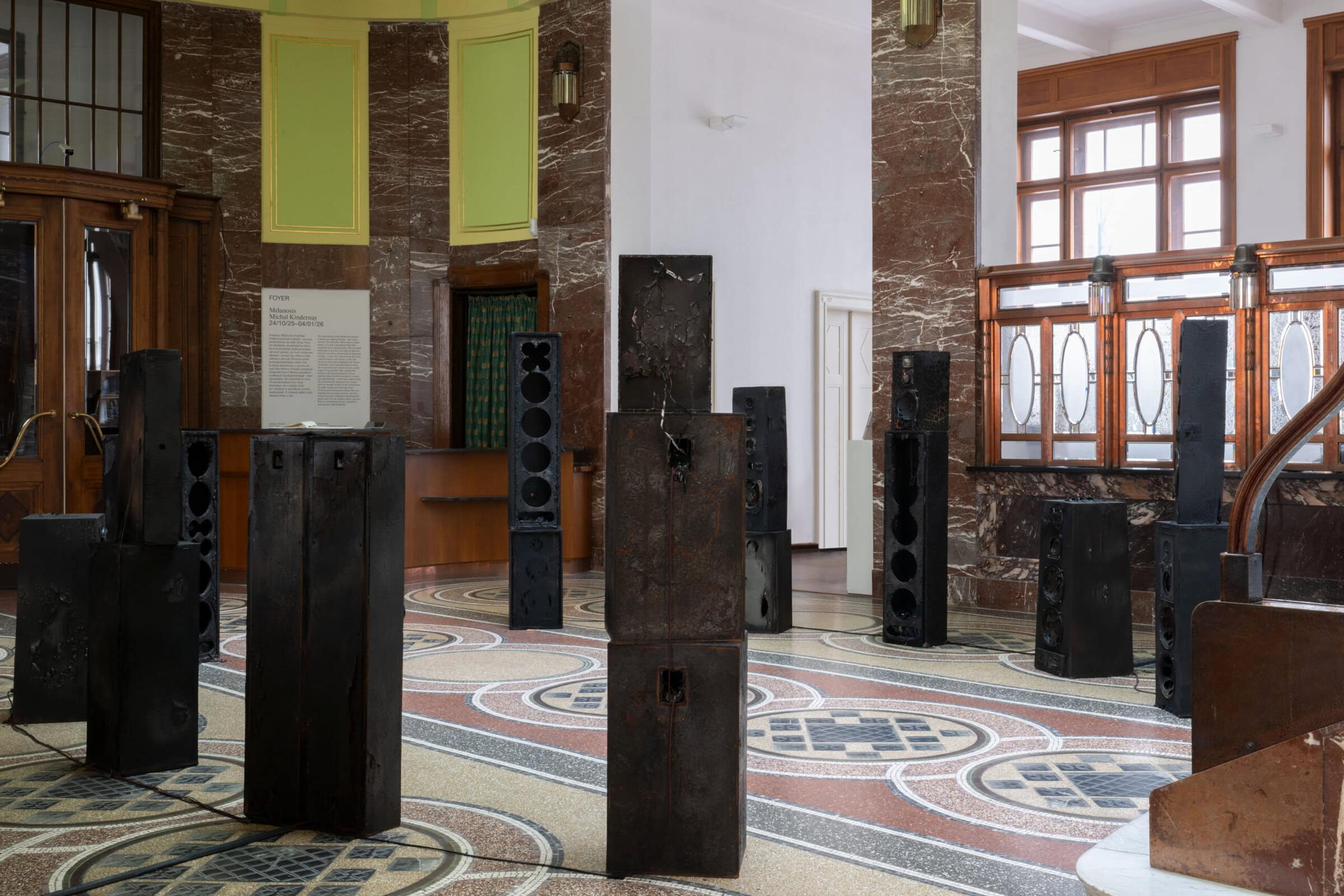
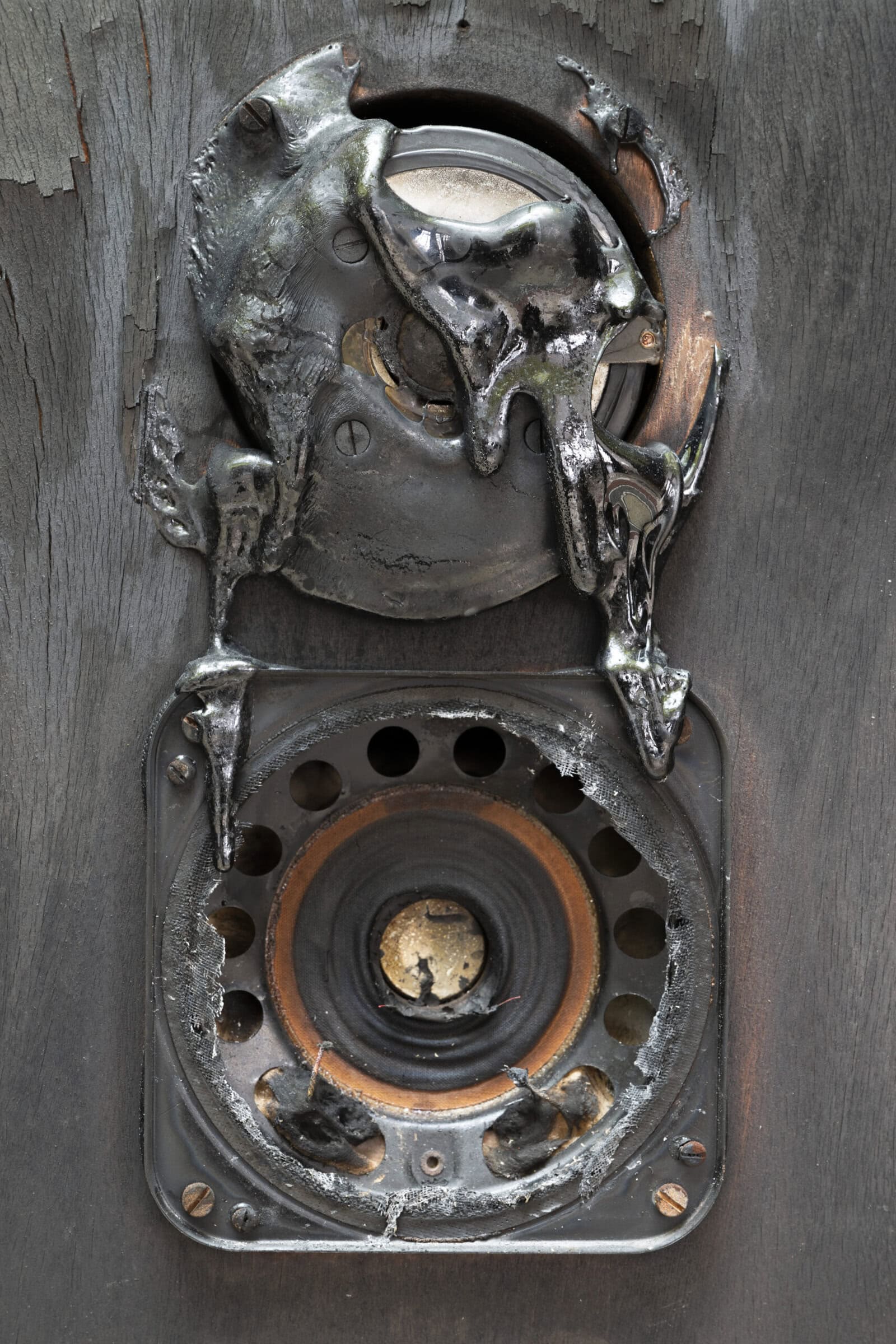
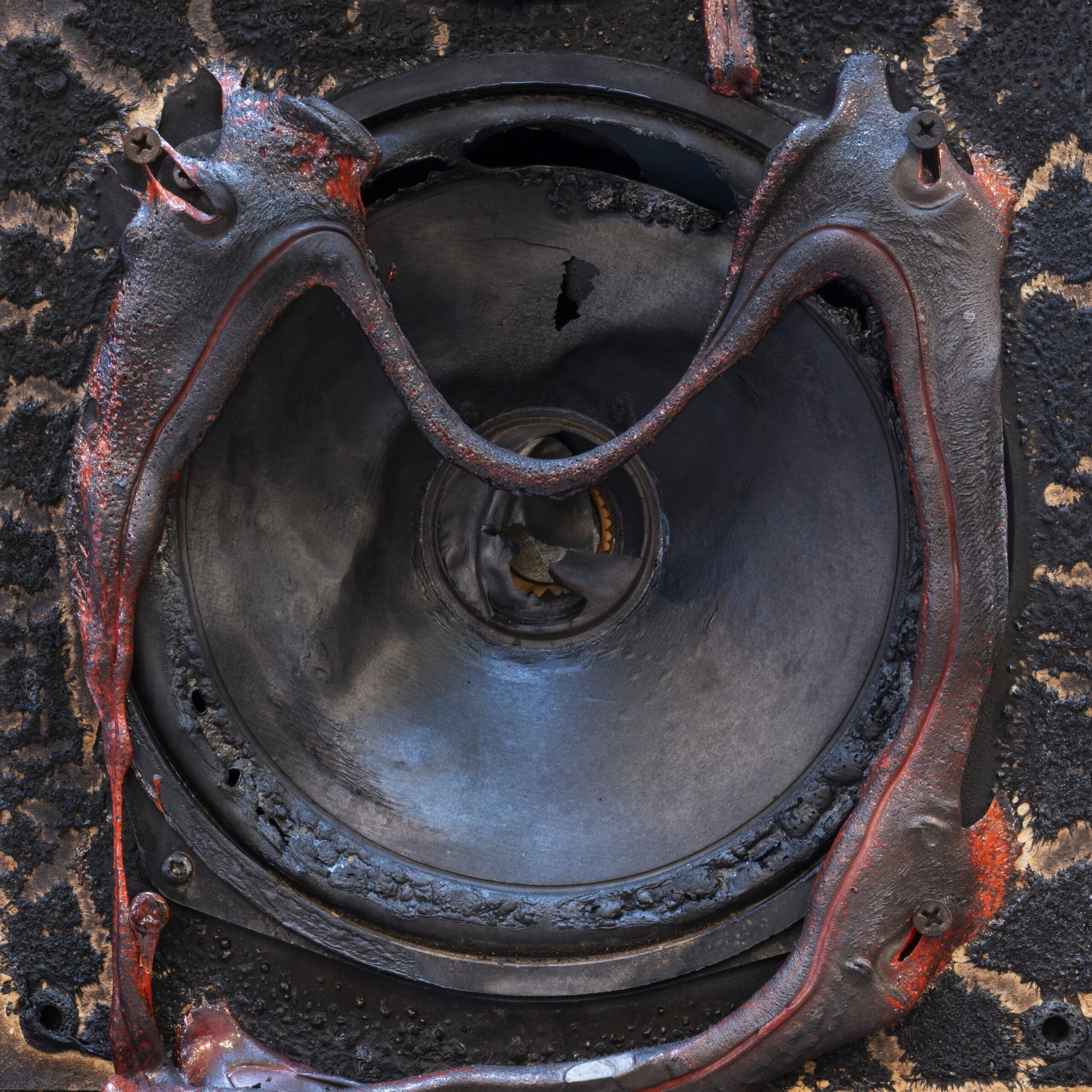
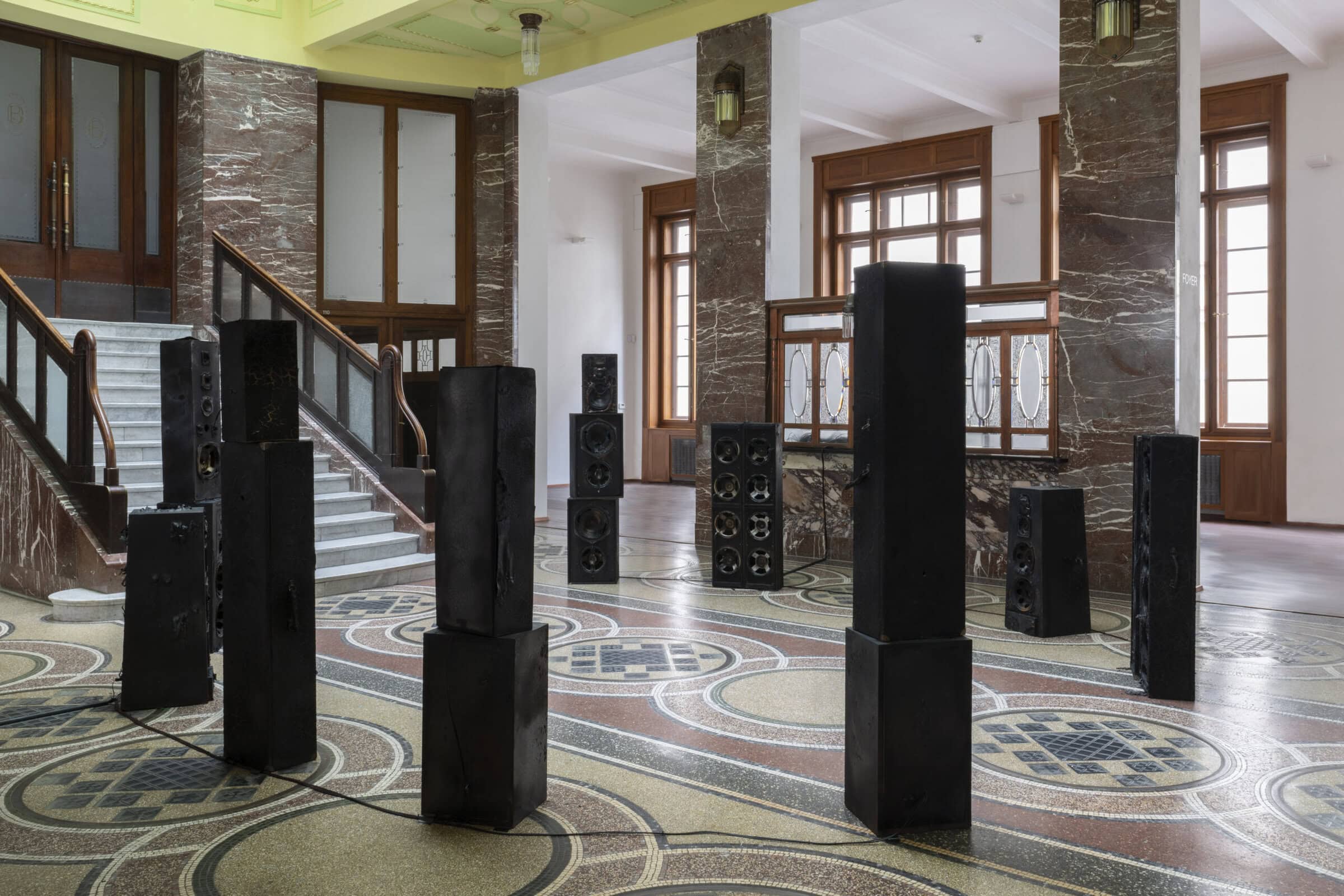
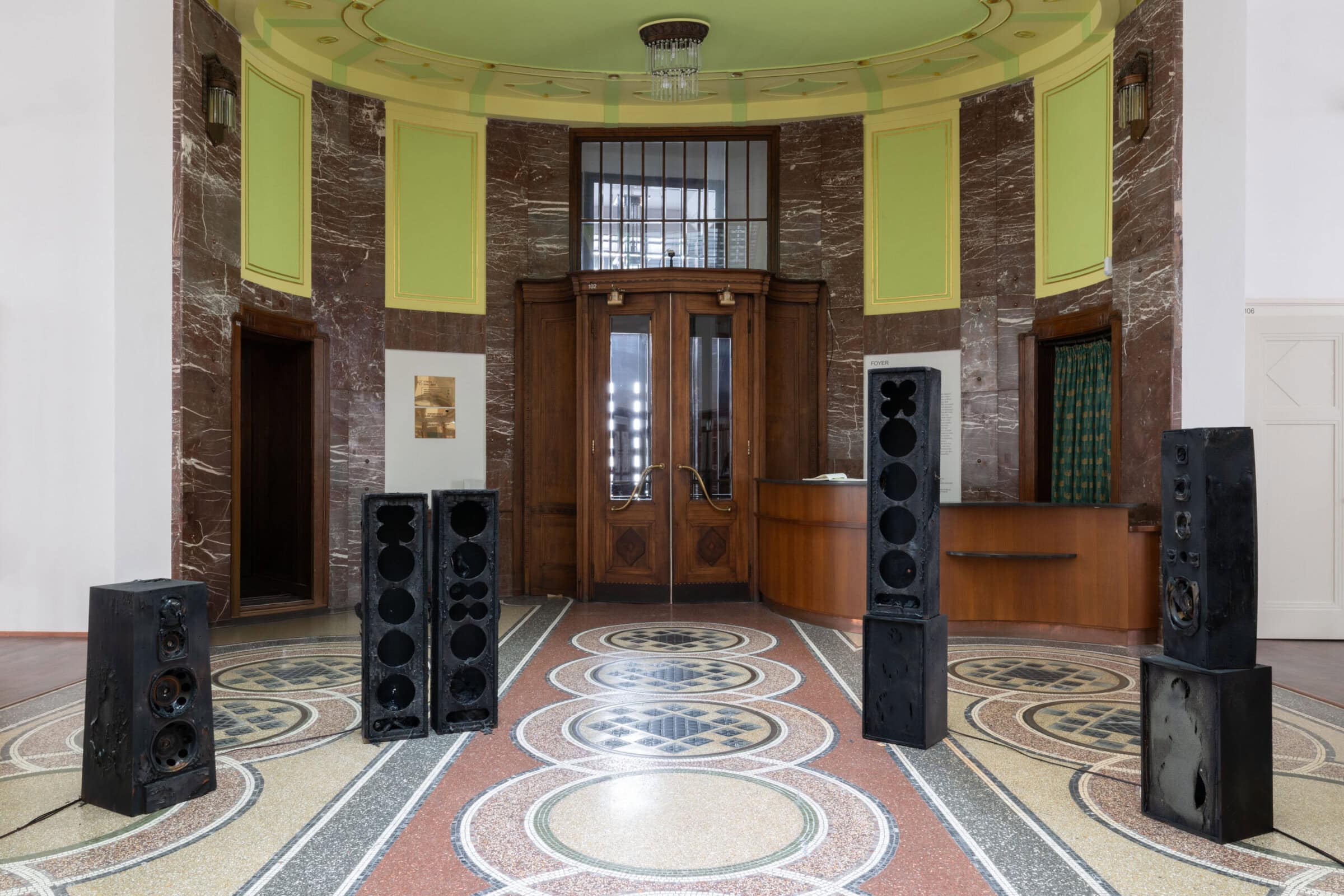
The site specific installation Melanosis consists of burnt speakers stacked into massive blocks, from which sound spreads into the space. The motif of a burnt landscape evoked by the installation serves as a metaphor for inner transformation. Michal Kindernay’s work contributes to the broader social debate on sustainability, animal extinction, the disappearance of fauna, and climate change.
The installation titled Melanosis depicts a landscape afflicted by fire – raw, transformed, but still alive. More than a silent object, it is also a pulsating body that responds and communicates. The scorched landscape of audio speakers is not just an entity of observation, it is an active component of relational ecology – a space for rediscovering the body, consciousness and nature, including its death and resurrection. A fire can seriously interrupt ecological and visual continuity, but it can also help to reset the ecosystem and return it to an earlier stage of succession (a state in which the landscape finds itself in a period of renewal or transition). The connection between the functioning of a forest and the inner world of people is a tenet of ecopsychology – a field that explores how the environment influences our psyche and our mental health.
Melanosis literally means darkening. The word comes from the Greek melas (“black”) and the suffix osis (“process”). Withing the context of the exhibition, it is a reference to melancholia, a charred landscape and a person’s mental state in the wake of destruction. The title thus evokes the physical transformation of the landscape by fire as well as a mental transformation resulting from sound and silence.
On a ritual level, the installation invites visitors to engage in introspection, to listen quietly, to confront emptiness and to consider the possibilities of rebirth. Sound is not an accessory here – it is an element that both animates and unsettles – like the breathing of a landscape that has survived fire. The sound comes from real recordings of a burning fire – the crackling of wood, the hissing of the flames, gusts of air, the resonance of the glowing heat. Using multi-channel sound and the placement of the speakers, the fire spreads through the space like a living organism: pulsing, hissing, dying down and coming back to life.
The installation’s aim is to present fire not as a destructive force but as an archaic memory and a bearer of warmth, transformation and purification. The multi-channel composition represents different types of fire – some frequencies crackle, others smoulder quietly, and others still resemble breathing. The carefully planned distribution of sound through the exhibition space creates an environment that forces visitors to slow down, listen and enter into a dialogue with this element.
The sound installation work with the motif of a scorched landscape, specifically the area of Bohemian Switzerland. Nevertheless, it is not meant as a direct reference to any natural catastrophe but as a metaphor for inner transformation. The situation in Bohemian Switzerland is one of many warning signs showing us how fundamentally the climate – and, with it, the whole world around us – has been changing.
MICHAL KINDERNAY (b. 1979) is an audiovisual artist, performer, and curator who ranks among the leading Czech creators of interactive video. He studied at the Faculty of Fine Arts at Brno University of Technology (Peter Rónai’s studio) and at the Film and Television Faculty of the Academy of Performing Arts in Prague (audiovisual media under Miloš Vojtěchovský). His work is an inseparable combination of research, software development, and tool design, and the work itself can take various forms during its realization. The ecological aspect of Kindernay’s work is also unmistakable. He deals extensively with various forms of pollution, not only in the form of direct visualization (Art Pollution Kit, Camera Altera), but also in the form of author’s commentary (the vrhlt series). His works include video performances and interactive installations, intermedia and documentary projects, and musical sound compositions. He is a co-founder of the art organization yo-yo, initiator of the RurArtMap project, and was a member of the Školská 28 gallery collective in Prague. He has taught in the master’s program at Prague College and externally at the Center for Audiovisual Studies at FAMU in Prague.
The exhibition is held as part of 800th anniversary celebrations of the town of Hradec Králové.